Massive Horus wall relief at Edfu Temple with a visitor showing its scale.

Edfu Temple: How to Visit Egypt's Best-Preserved Temple of Horus

Edfu Temple stands on the Nile's west bank, roughly halfway between Luxor and Aswan, and it's one of the best-preserved temples in Egypt. Built betwee...

Granite falcon statue of Horus beside the Temple of Edfu wall in Egypt.

Edfu Temple: How to Visit Egypt's Best-Preserved Temple of Horus

Sacred sanctuary and granite shrine inside the Temple of Horus at Edfu.

Edfu Temple: How to Visit Egypt's Best-Preserved Temple of Horus

Halfway between Luxor and Aswan, on the Nile's west bank, sits a temple that spent over a thousand years buried under sand. That's the reason it survived so well. While other temples lost their roofs to weather, looters, and time, Edfu's stayed covered until 1860, when Auguste Mariette cleared it out. Walk in today and you're looking at walls, columns, and ceilings that are close to what Ptolemaic priests saw.

The temple belongs to Horus, the falcon god tied to kingship. Construction ran from 237 BC under Ptolemy III through nearly two centuries of his successors. If you're doing a Nile cruise between Luxor and Aswan, Edfu is almost certainly on the itinerary, usually alongside Kom Ombo. It also works fine as a standalone day trip either direction.

What to See Inside Edfu Temple

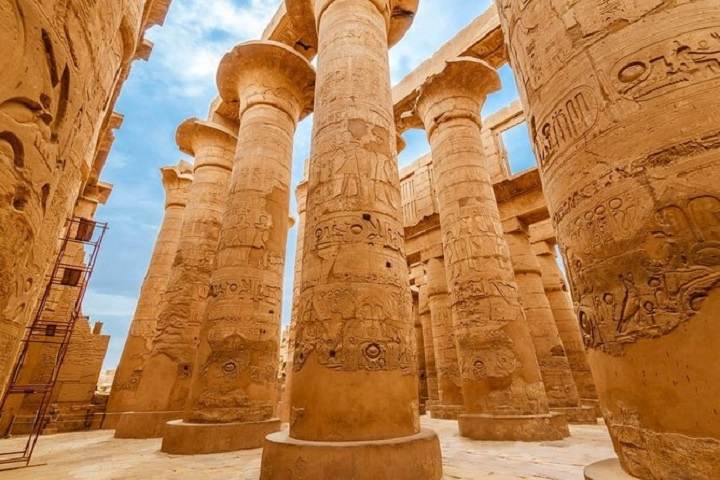
A pylon 36 meters tall marks the entrance. Ptolemy XII had himself carved into it, smiting enemies in front of Horus and Hathor. Standard pharaonic self-promotion, just done two thousand years earlier. Past the pylon is an open courtyard lined with columns on three sides. The reliefs here don't just show gods; they document the temple's own construction, down to the ropes and tools workers used. That level of self-documentation is unusual for an Egyptian temple.

Two hypostyle halls come next. Some columns still have flecks of the original paint. The ceiling in the outer hall carries astronomical scenes worth looking up for. Beyond that is the sanctuary, the building's core, where a granite shrine, older than the rest of the structure, once held the barque of Horus. Few Egyptian sanctuaries have survived this intact.

Outside the main building there's a Nilometer (used to gauge flood levels, which mattered for tax purposes) and a small birth house, or mammisi, marking the divine birth of Horus.

The Myth Behind the Temple: Horus vs. Set

The rear exterior wall tells a specific story: Horus battling Set, the god blamed for killing Horus's father Osiris. First Horus appears as a winged sun disk. Then he's a man with a spear. Set shows up as a hippopotamus, driven out of the sky and finally into the water. It's a fairly literal depiction once you know what you're looking at. Before that, it's just carved shapes.

Priests once acted this out. Every year, a statue of Hathor traveled south from Dendera for what was called the Feast of the Beautiful Meeting, a festival that ran about two weeks and marked her symbolic marriage to Horus at Edfu. It was one of the bigger dates on the Ptolemaic religious calendar.

Getting There

Cruise passengers dock a short walk from the temple and usually finish the trip by horse-drawn carriage. Fares aren't fixed, so agree on a price before you get in. Drivers expect the back-and-forth and won't be offended.

Driving from Aswan takes about 90 minutes each way (roughly 105 km). From Luxor it's a similar drive time, closer to 115 km. Either direction, hiring a car for the day makes sense if you want to add Kom Ombo to the same trip, which most people driving through do anyway.

There's also a train. Edfu has its own station a few kilometers out, connected to both cities on the Upper Egypt line. It's cheap, but the schedules don't cooperate well if you're trying to see more than one temple in a day. A car gives you more control.

If you're building out the Aswan side of the trip too, our guide to things to do in Aswan covers the rest of it.

When to Go, How Long to Stay

The temple faces east. Morning light hits the pylon and courtyard straight on, so getting there by 7 or 8 AM means good light and no crowds yet. By mid-morning, cruise groups start arriving in numbers. Afternoons thin out again, though the light's flatter for photos by then.

Budget 90 minutes to two hours. It's not a massive site, but the reliefs are dense enough that rushing through misses most of them. A flashlight (your phone works) helps in the darker corners of the hypostyle hall.

A Few Things Worth Knowing Before You Go

Guides help here more than at most sites, since the wall carvings assume you already know the mythology; without context they're just decoration. That said, if you're pressed for time or the site's packed, going in alone still works.

Bring water and something for your head. The courtyard has zero shade, in any season.

Carry small bills for the carriage and any vendors, even if the ticket counter itself takes cards.

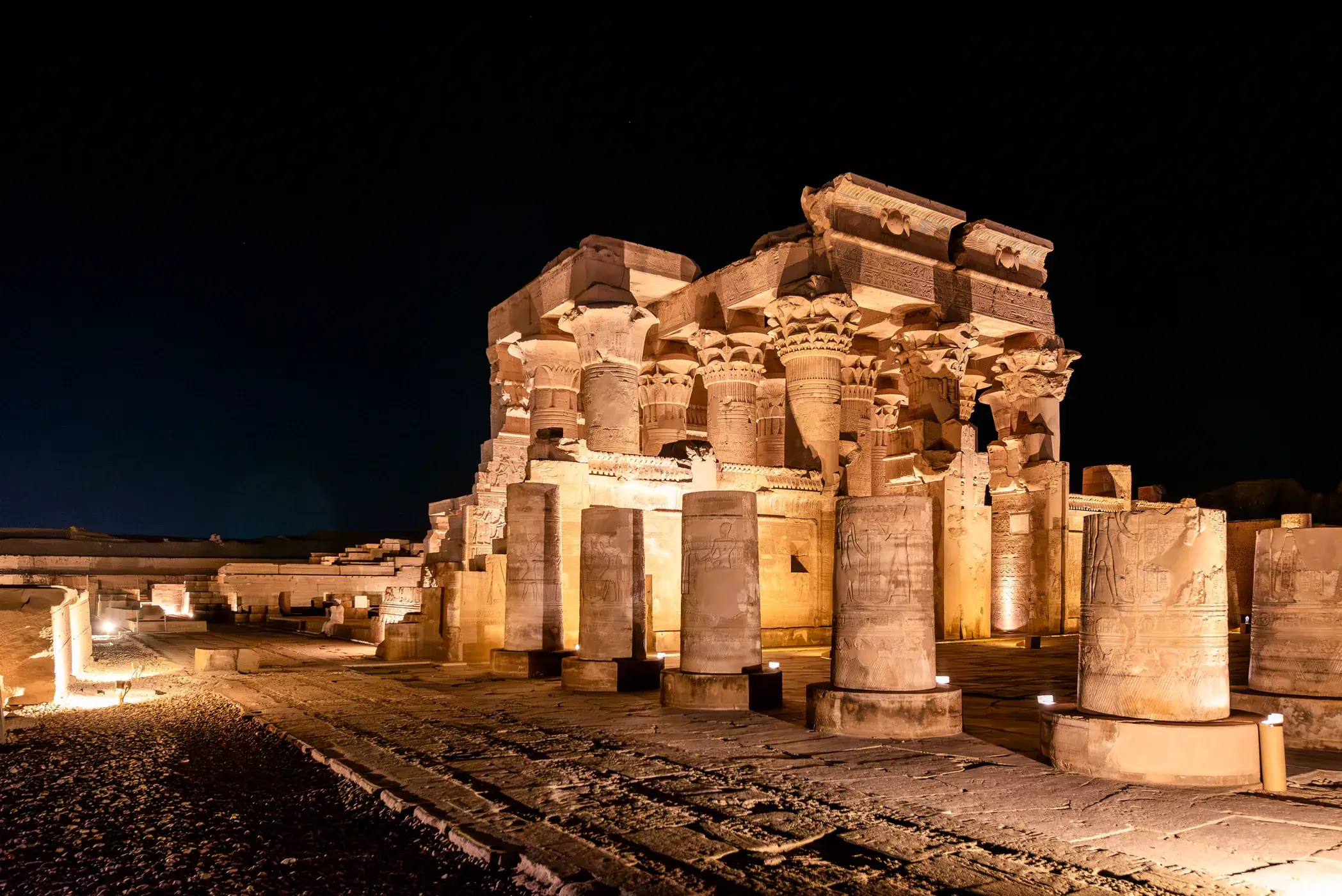
If you're choosing between Edfu and Kom Ombo and can only manage one: Edfu is bigger, better preserved, and has the more dramatic pylon and halls. Kom Ombo is smaller, but it's a double temple, shared by Horus and the crocodile god Sobek, and its riverside position gives it a different kind of appeal. Most people visiting Upper Egypt end up seeing both anyway, usually on the same day.
Why Choose Aten Tours

Choose Aten Tours for unforgettable journeys, carefully curated itineraries, and premium travel experiences. We combine local expertise with world-class service to make every trip exceptional.

Secure Online Payment

Enjoy safe and secure online payments with full protection of your personal and financial information. Book your trips with confidence anytime, anywhere.

Help & Support

Travel with confidence knowing that our Help & Support team is always here for you. From booking to your return, we’re just one message away.

Tailored Travel Experiences

Your journey, your way. We design tailored experiences that match your style, ensuring comfort, flexibility, and unforgettable moments in every destination.

Client Testimonials

At Aten Tours, we are proud to create experiences that leave lasting memories. Read genuine feedback from travelers who explored Egypt’s wonders, enjoyed luxury holidays, and discovered the world with confidence and ease.

Traveling solo in Egypt with Aten Tour was one of the best decisions I made. As a 22-year-old female traveler, I was a little nervous before arriving, but I felt safe and well looked after from day one. Everything was well organized, my guide was knowledgeable, kind, and always happy to help, and I never had to worry about a thing. The whole trip was smooth, enjoyable, and filled with unforgettable moments. I'm so glad I chose Aten Tour and would definitely travel with them again.

Sarah
Sarah May 2026

My fiancé and I booked a private 5-day tour of Egypt with Aten Tours, covering Cairo, Aswan, Abu Simbel, and Luxor. From the moment we arrived, everything was perfectly organized. The team took care of every detail, making our trip completely stress-free. Our guides were knowledgeable, friendly, and passionate about Egypt's history, and every destination exceeded our expectations. Even after returning home, we still find ourselves talking about this unforgettable experience. We highly recommend Aten Tours to anyone looking for a well-planned and memorable trip to Egypt.

Thomas
Thomas May 2026

Traveling with Aten Tour made our vacation completely stress-free. Every hotel, transfer, and excursion was exactly as promised, and the team was always available whenever we had a question. We really appreciated the personal attention and warm hospitality throughout the trip. We came home with unforgettable memories and would definitely recommend Aten Tour to anyone planning a trip to Egypt.

Olivia
Olivia April 2026

We booked an 8-day trip with Aten Tour, and it turned out to be one of our favorite vacations. Everything was well organized from start to finish, which made traveling around Egypt really easy. We never felt rushed, the hotels were great, and the team was always helpful whenever we needed anything. Egypt had been on our bucket list for a long time, and we're so glad we chose Aten Tour for this experience.

Nicholas
Nicholas July 2026

Our family booked a tour with Aten Tour after reading several positive reviews, and they definitely lived up to our expectations. Communication before the trip was quick and helpful, and everything during the tour was exactly as described. The hotels were comfortable, the transportation was smooth, and the guides made every stop interesting with their stories and local knowledge. Egypt had always been a dream destination for us, and this trip made it even more memorable.

Emma
Emma June 2026

All FAQ about Egypt

All FAQ about Egypt

Construction began under Ptolemy III in 237 BC and continued under his successors for close to 180 years, finishing around 57 BC. That makes Edfu one of the last major temples built in ancient Egypt, constructed during the Greek-ruled Ptolemaic period rather than earlier pharaonic dynasties, though it follows the same traditional temple layout.

A guide isn't required, but it helps significantly. The temple's reliefs depict specific myths, especially the battle between Horus and Set, that are easy to overlook without context. A self-guided visit still works well if you're short on time or prefer exploring independently.

Edfu is larger and more architecturally complete, with a dramatic 36-meter pylon and two intact hypostyle halls, dedicated solely to Horus. Kom Ombo is smaller but unusual as a double temple shared by Horus and the crocodile god Sobek, set on a riverside bluff. Most travelers visit both on the same day between Luxor and Aswan.

Edfu Temple is an ancient Egyptian temple dedicated to Horus, the falcon-headed god of kingship. It sits on the Nile's west bank between Luxor and Aswan and was built between 237 and 57 BC under a series of Ptolemaic rulers. Buried under sand for over a thousand years, it's now one of the best-preserved temples in Egypt.

94%
WhatsApp Call