Bibliotheca Alexandrina: History, Architecture, and What to See Inside
What Is the Bibliotheca Alexandrina?
Egypt built a new library on Alexandria's Corniche in 2002, on the coastline where the ancient Library of Alexandria is believed to have stood roughly 2,300 years earlier. The project ran into the hundreds of millions of dollars, with UNESCO and the Egyptian government both backing it.
Nobody has ever confirmed exactly where the original library stood - no wall, no column, nothing definitive. This building isn't a reconstruction of it. It's something new, sitting on ground that once belonged to Ptolemaic Alexandria's Bruchion district.
What's inside now: millions of books, four museums, a planetarium, reading rooms built for thousands. Less a single monument, more a small district - library, research institutes, event spaces, all stacked along the same stretch of coast where scholars worked two millennia ago.
History: From the Ancient Library of Alexandria to Its Modern Revival
The idea surfaced in the 1970s, when Alexandria University proposed reviving the city's lost library. UNESCO signed on in 1990. A design competition followed, construction started in 1995 next to the university, and the doors opened in October 2002.
The original library goes back to around the 3rd century BC, under the Ptolemaic dynasty - one of the largest collections of written knowledge in the ancient world, with scholars credited for foundational work in mathematics, astronomy, and medicine. What ended it is still argued over. A fire during Julius Caesar's campaign in 48 BC is one theory. A slower decline through the Roman and early Christian periods is another. Neither fully holds up on its own.
When crews broke ground in the 1990s, they hit Roman-era villas, mosaic floors, artifacts from the old Bruchion district. Much of it sits on permanent display now, a few floors below the main reading room.
The Architecture - Why the Building Is Tilted Toward the Sea
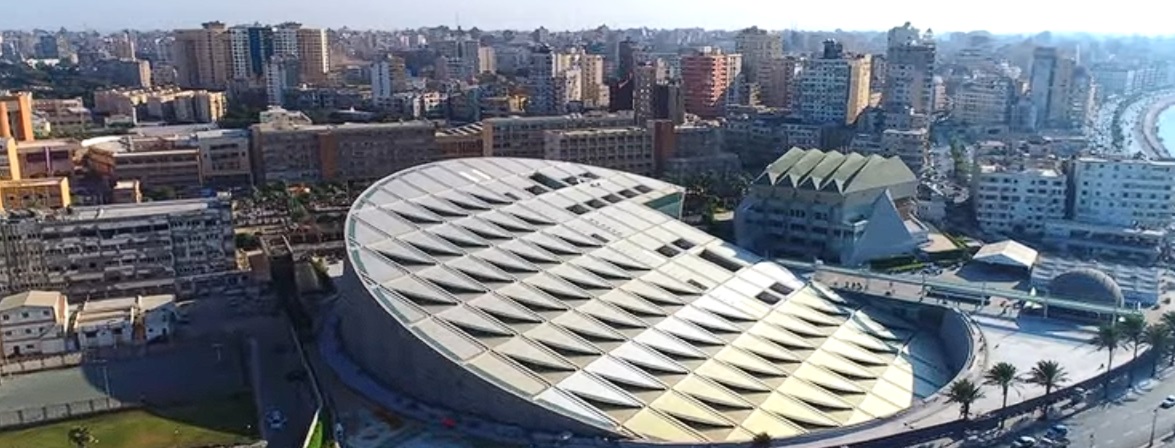
A granite disc roughly 160 meters across, tilted about 16 degrees toward the Mediterranean. Norwegian firm Snøhetta won the design competition for it in 1989, and the tilt was intentional - modeled on a sun rising out of the sea, a reference to the Egyptian god Ra.
Someone has to point that out to you, usually. I assumed it was just structural the first time I heard the explanation.
The exterior is Aswan granite, carved with about 4,000 characters pulled from writing systems spanning 10,000 years - cuneiform a few meters from Korean hangul. Walking the full perimeter takes ten minutes at a slow pace, though most visitors stop at the entrance and never see the rest of the wall.
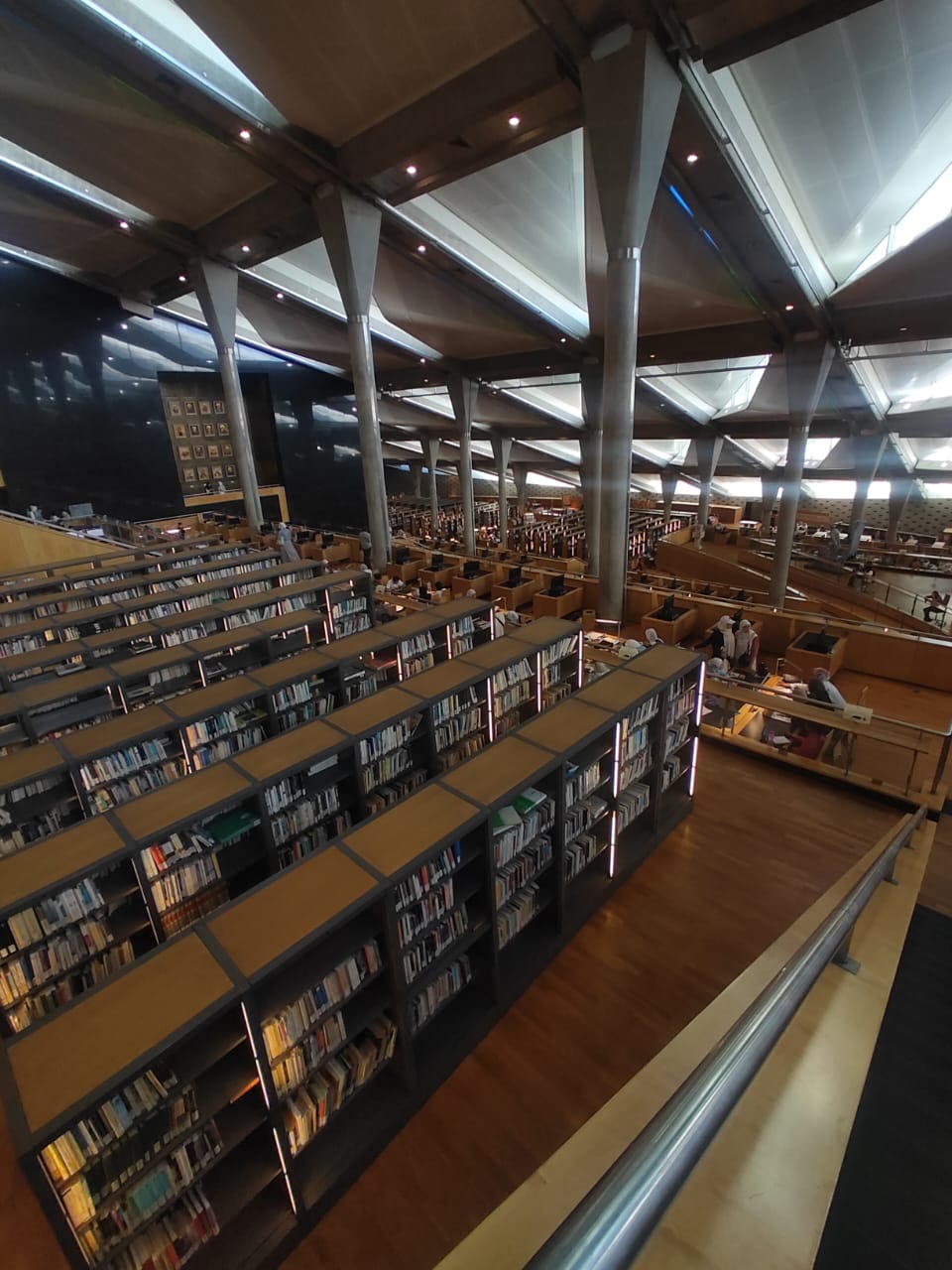
Inside, the main reading room descends in terraces under the tilted roof, lit mostly by skylights, built for thousands of readers. It doesn't read like a library floor so much as an amphitheater someone filled with books.
What's Inside: Museums, Planetarium, and Reading Rooms
Four museums share the complex with the library itself. The Antiquities Museum, below ground level, holds objects from the library's own construction site, pieces pulled from underwater digs in the harbor, and a broader collection running from Pharaonic through Greek and Roman periods. The Manuscript Museum covers rare manuscripts and historical documents, including facsimiles of major scientific and religious texts. A Sadat Museum traces the life of former president Anwar Sadat. A Science Museum targets younger visitors.
There's a planetarium too, plus rotating exhibition halls and a conference center still used for academic and cultural events. All of it sits inside or right around the same building, so nothing here needs its own trip.
Visitors can walk the reading rooms as part of a regular visit, no membership required. With limited time, the Antiquities Museum is worth prioritizing over the Sadat and Science museums - it's the one tied directly to what's under the ground you're standing on.
Tickets, Opening Hours, and How Much Time to Plan
150 EGP gets a non-Egyptian adult a Main Library ticket, covering guided tours, the Culturama shows, the Sadat Museum, and the exhibitions. 300 EGP buys the inclusive ticket, adding the Antiquities and Manuscript Museums. Buying either museum separately - 100 EGP and 60 EGP- adds up to more than the inclusive price. Egyptian citizens pay far less (10 EGP and 50 EGP), and special-needs visitors enter free.
Hours split into two schedules. Saturday and Sunday run 10:00 am to 2:00 pm - shorter than most people expect. Monday through Thursday runs 10:00 am to 6:00 pm. A weekend morning arrival beats an afternoon one, given how narrow that window is. Hours shift around Eid and other religious holidays, so check bibalex.org close to your travel date.
Plan on 1.5 to 2 hours for the library alone, 3 to 4 with a museum or the planetarium folded in. Guided tours run in Arabic, English, and French on a fixed schedule - English starts at 10:45 am on weekdays, roughly hourly after that, fewer slots on weekends. A Main Library ticket covers admission to one.
How to Get There from Central Alexandria
The library sits on the Corniche in El Shatby, next to Alexandria University, on the eastern edge of the city near the harbor. A short tram ride east from Raml Station gets you there, or about ten minutes by taxi along the waterfront, traffic depending.
Most visitors take a taxi, especially if the library is one stop among several that day - the driver can loop through nearby attractions without much backtracking. Buses and microbuses run the Corniche too, slower and less obvious if you don't already know the routes. Staying nearby? Walking works fine.
Practical Tips Before You Go
Worth the trip, for anyone into history or architecture. Not a five-minute stop, though - 1.5 to 2 hours, minimum, or the visit turns into a rushed lap around a building that deserved more attention.
No food, drinks, or smoking inside; grab coffee at one of the cafés by the entrance first. Every public area has ramps and elevators, and wheelchairs are available at the visits reception desk on request. Mornings are quieter, with softer light through the skylights. Late afternoon works better for the exterior wall, before the light drops.
The reading terraces, the museum galleries, the carved wall up close - none of it comes through from the Corniche. You have to be inside it.